BEARS - Margaret
ART
- THE IRISH BEAR
by Margaret
There is evidence that in Ireland during the Iron
Age (800BC - 43AD), the bear was admired for its strength and ferocity. It was
thought to have much in common with humans as it walked on two legs, was
omnivorous and liked the same foods, honey, salmon, fruit, nuts and meat.
Bones of bears dating back over 10,000 years have
been found in caves in counties Clare and Leitrim. Recent work by researchers
from the Institute of Technology, Sligo and Queens University, Belfast has
dated two distinct sets of bones found in the Aillwee cave Co Clare in 1976 to
10,400 years ago and 4,600 years ago. The bones of the more recent bear show
butchery marks which suggests that bears were hunted, or at least that
carcasses of bears dying of natural causes were exploited for their valuable
skins, fat and meat. In the Alice and Gwendoline cave in Co Clare ancient bones
were discovered in 1902, recently, researchers analysing these bones have
discovered cut marks on bear patella indication that somebody had been trying
to remove tendons. These may have been used for sewing fletching or hafting.
This group of bones has been dated to between 10,860 and 10,641. Perforated
bear’s teeth, worn as necklaces have also been found Co Clare. The cave of Poll
na mBear in Co Leitrim contains the bones of a number of bears and their cubs,
dating to 2,000BC. DNA research on these bones shows that Irish bears were the
maternal ancestors of the Polar bear, which gives evidence that the Irish bear
must have bred with the archaic polar bear.
The people of pre-Christian Ireland had no
first-hand knowledge of bears, as by the Iron Age they had already become
extinct. Actual bear imagery both literal and visual is rare but a group of
three stone bears of the era were found during the re-building of Armagh
cathedral in 1840. The previous cathedral had been built on an Iron Age burial
mound and the statues are clearly connected with this.
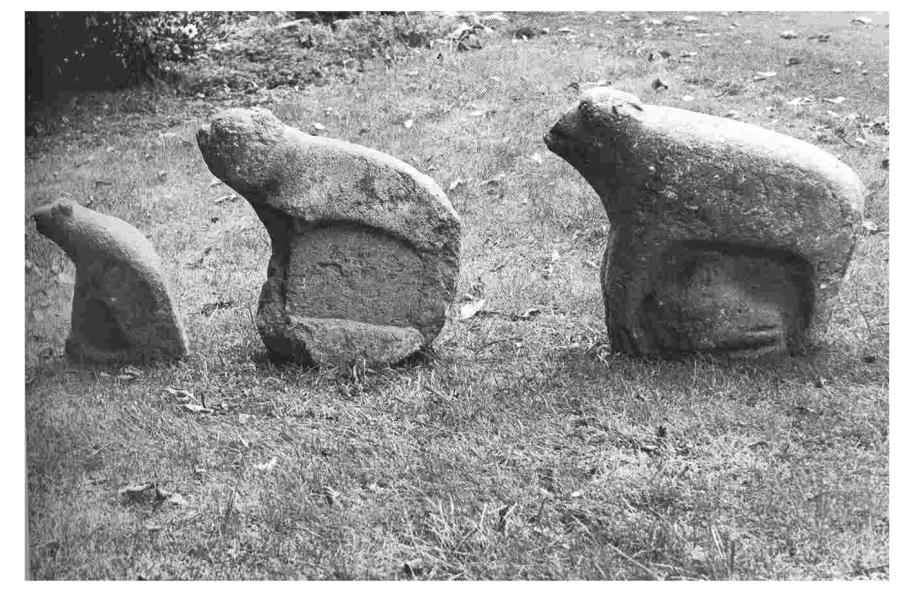
Although there is no written history, stories have
come down to us through the Irish oral tradition. Tales such as the “Cattle
Raid of Cooley” (An Tain Bo Cualnge) and of Cuchulainn and the Red Branch
Knights, are from this time. We know that bears were held in high esteem as in
the second century BC a high king of Ireland, Art Oenfer (Lonely Bear) was the
son of Conn mac Airt. In modern times the family name O’Hart comes from
macAirt, son of the bear.
With the introduction of Christianity into Ireland in the fifth century many abbeys developed across the island. In 589AD Columbanus set off with twelve companions, one of whom was Gall, from the abbey of Bangor to bring Christianity to Northern Europe. They settled in Luxeuil in France and then in Bregenz in Austria. Columbanus eventually moved on to Bobbio in Italy but Gall stayed in Bregenz and became a hermit in the woods. The story goes that one night while sitting by his fire he was charged by a bear. Gall rebuked it and the bear stopped in it’s tracks and disappeared into the woods to return with firewood, and the two shared the fire.

For the rest of his days Gall was always accompanied by his bear.


We went on a tour of the Aillwee Caves earlier this year! Wish I'd know about this before hand 🐻
ReplyDelete